Archive for the 'Homebrewing' Category

Homebrewing Taste Test

Well my second batch of homebrew is more or less complete. I kegged it a week ago and have had it hooked up to my CO2 tank since. I probably could have had it ready a little earlier had I rocked it more than the half dozen or so times that I did. We tried it this past Sunday evening, and it had a long way to go still. Our neighbors joined us for this tasting, and since it was a bust, I had them try my first batch of homebrew that I bottled awhile back.

Upon opening up a couple of the first batch bottles, I was surprised to see how carbonated the beer was. Both of our neighbors immediately said that it wasn’t too bad after their first few sips. I was shocked! So I tried it once more and I had to agree with them. It appears that it might have aged a bit since my last tasting. Maybe I won’t have to settle for using this in my cooking only. I threw a couple more bottles into the refrigerator and I hope to give it another try after work today.

I did try the second batch again last night and it was much more carbonated. It still tasted a bit fruity to me, which I’m not expecting from a Pale Ale. I’ll pour another one of these today as well so that I can compare and contrast it with the first batch. Should make for an interesting tasting session.

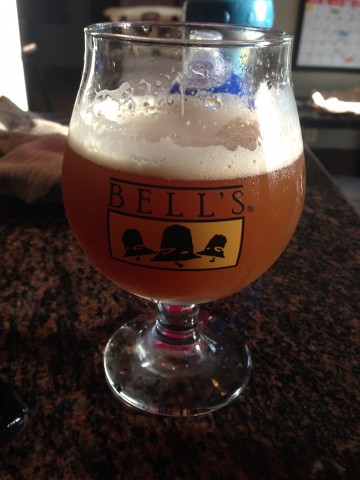
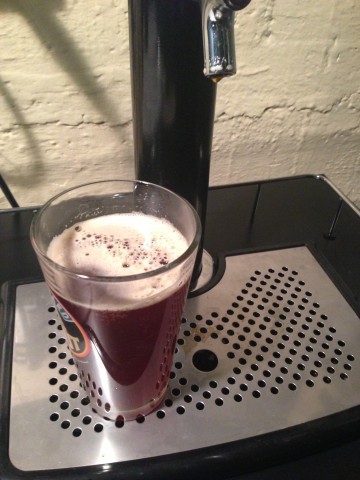
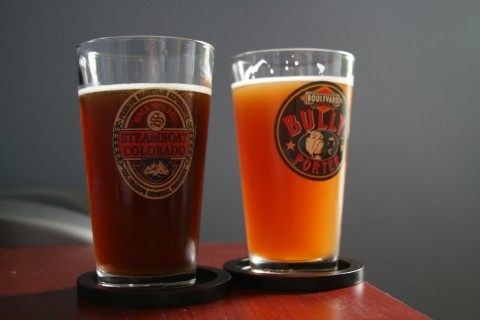
Update: Taste test has begun. Pictured below is batch 1 (autumn amber ale) on the left and batch 2 (english style pale ale) on the right.

Taste Test

Big Willie Pale Ale

In a couple hours from now I’m hoping to have my second batch of homebrew successfully kegged and then I will start the carbonation and cooling process. I just popped open the fermenter and took a specific gravity reading of 1.018. This isn’t much lower than the first batch (1.020), but the difference this time is that I started at a higher starting gravity of 1.050 (vs 1.045). This should equal out to a nice beer at 4.3% alcohol by volume.

Earlier today I made some modifications to the lines in the kegerator using this quick disconnect set, so that I can now easily switch from the lines needed for the Cornelius keg for homebrewing to the other lines and tap needed for a standard keg of beer, the Sanke keg. I also took apart my Cornerlius keg for cleaning and sanitizing. In a little bit I am going to put it all back together, finish the sanitizing and pressurization checks, and then I will move the beer from the fermenter to the keg. I’m hoping that by the end of the weekend I’ll be able to pour my first glass of Big Willie Pale Ale.

Big Ben Pale Ale

With mixed results from my first homebrew, I’ve decided to move on and start on my second batch. My parents sent a kit for Big Ben Pale Ale for my birthday a couple of months ago. I cracked open this box and finally got around to brewing it a couple of Saturdays ago. I followed pretty much the same system as I used the first time in the brew process. Once again I was happy to find some bubbling in the airlock the day after brewing, so at least the fermentation started alright. I hope it does a little better this time around, and I’m thinking it should since the fermenter is at a slightly higher temperature than the first time.

I’m hoping the fermentation will be finished this coming weekend, and then this time I will transferring it all into a Cornelius keg (also a birthday gift) instead of bottling it all. This is supposed to be much easier than bottling, and I should be able to carbonate the beer really quickly with some forced CO2. I still have to make some modifications to my lines in the kegorator, but eventually that’s exactly where this brew is going. I can’t wait to have my own beer ready and waiting on tap at all times. I just hope I enjoy this batch a little more than the last, which I’ve started using in some of my cooking. I used a bottle of the beer in place of water in a recent batch of turkey chili. I think this really added to the flavor of the food, and I’m happy I’ve found a use for it!

You Call That Beer?

So, here’s a long overdue update to my homebrewing project. After bottling all of the beer, I let them sit for over two weeks (closer to three if I remember correctly) and then I put a few of them into the refrigerator. Once chilled, I cracked a couple of them open and immediately had mixed feelings. First, one of the bottles appeared to carbonate much more than the other. So they poured very different from each other and even tasted a bit different. And i will admit that neither of them tasted very good. Though it does appear to be an amber ale it tastes more like a wheat or light bock. So far I think I’ve gone through less than half a dozen bottles, so there is still plenty left. I’m now debating just dumping most of it and trying again, as I would definitely give this one a below average grade. Here’s hoping for better luck next time.

38 Bottles Of Beer…

Despite my efforts last week to restart the fermentation of my homebrew, I opened the bucket last night to find it still stuck at 1.020. I decided to give up on any additional fermentation and decided to bottle the beer last night. To do this I used a racking tube and hose to siphon the beer from the fermentation bucket to the bottling bucket. Before starting the flow, I added a dissolved corn sugar mixture to the bottling bucket. I accidentally stopped the siphoning a little early, and only ended up with 4 gallons of beer in the bottling bucket. I tried restarting the siphon, but just ended up stirring up the sediment and decided to discard the remaining gallon.

With the beer transferred over to the bottling bucket, I reattached the hose to the spout on the bucket and attached the bottle filling wand to the other end. Filling the bottles was pretty simple, but a little messy if I accidentally overfilled them. Instead of using the sanitizing mixture provided with my kit, I sanitized the bottles using the dish washer. I didn’t add any detergent or sanitizer to it, just let it run with water and the sanitizing is actually done via the heat of the dry cycle.

When all of the bottles were filled and capped, I put them back into the boxes they arrived in, which should provide enough darkness for the carbonation stage that should last the next few weeks. I’m not putting them back into the same closet I used for fermentation and instead trying out a warmer corner of the house. Since I didn’t have the full 5 gallons transferred, I ended up with just over one and a half cases of beer. Not bad for a first attempt, now I just hope it carbonates and will taste good.

Stuck Fermentation

I was hoping to bottle my homebrew this week. However, after I opened up the fermenter I took a specific gravity reading of around 1.020. I was hoping to be in the neighborhood of 1.010 according to the directions. It appears that my beer is a victim of a stalled fermentation, likely due to the temperature being too low. I figured the basement would have definitely been too cool, so I placed the beer in a first floor closet off of the office. I was hoping that this would keep it around 65 degrees, which should be a satisfactory temperature. However, I noticed that the thermometer on the bucket read under 60 degrees. I guess I should have watched it a little closer.

So, I managed to bring the temperature back up to around 65. I also spun/rocked the bucket a little bit to stir things up, and finally wrapped it up in an old blanket. I then put it back in the closet and I’m hoping after this weekend that it fermented a little more. The temperature seems to be warmer than it was earlier, so that’s a good sign. If this doesn’t work, I guess I’ll bottle it anyway, though the alcohol content won’t be as high as it should. Currently it is around the level of 3.2 beer.

Paff’s Blue Ribbon

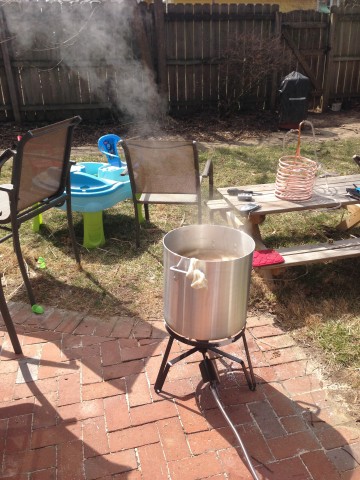
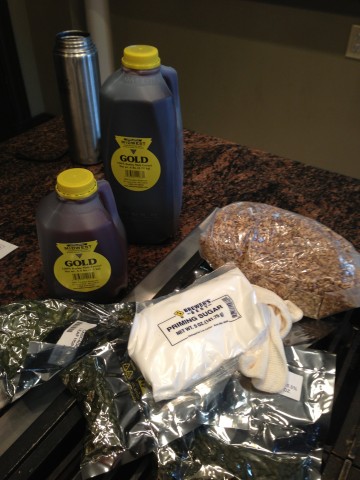
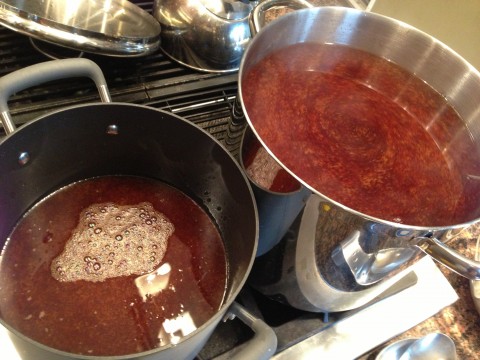
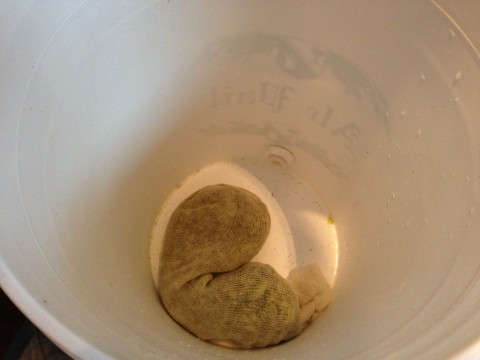
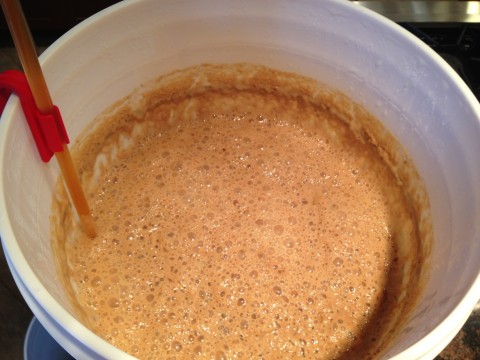
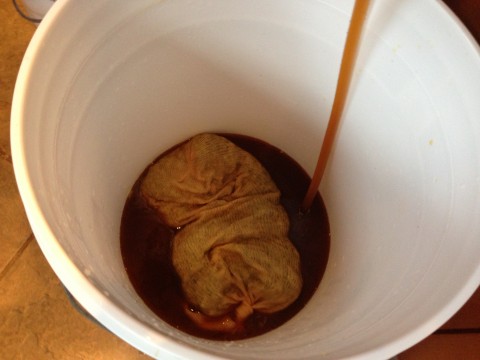
Saturday was mostly dedicated to my most recent hobby, homebrewing. My parents sent a starting homebrew equipment kit from Midwest Supplies to me as a Christmas gift. In addition to everything I needed to start brewing, it also included the needed ingredients for my very first batch of beer, an amber ale. So I successfully (at least so far) steeped some grains in the large pot, added some malt extract, brought the mix to a boil, added hops to the boil, cooled down the wort, transferred to a fermenting bucket, and added the yeast. I think those were the basic steps I took so far. Oh yeah, lots of sanitizing various equipment as well. I checked on it this morning to find some bubbling in the airlock that sits on top of the fermenter, which is a great sign. Now I must wait for the fermenting to finish, at which time I will attempt bottling.